4. Olive Oil, Old Baths, Festival, Picnic, Last Bikes,
- writedanielwatson
- 6 hours ago
- 11 min read
Day 8. Thursday 5/29/26
Transit from Cortona to Montepulciano. Hike around Lake Castiglione.
Leisurely morning hike around Castiglione Lake. One of the largest (?) lakes in Italy. Relaxing walk. Hiked around and through Castiglione Castle. Old.
Coffee. We stopped for coffee.
Café = espresso. Tiny cup. Bitter. Shoot it straight or add some sugar.
Cappuccino = espresso + milk (baristas, you can drop a comment to specify how much and to correct all of this.) In Italy, a cappuccino is a before-Noon drink. You simply don’t order one after that. Unacceptable.
Normally, I went between café and cappuccino, depending on how Italian I'm feeling.
This morning I thought I would try something new and order a latte. They asked if I wanted it cold or hot. I said hot. Welp, I learned/remembered: "latte" literally means "milk". They handed me a cup of steamed milk. Ha! Not what I had in mind, but I put some sugar in it, and it was delicious.

Private Olive Oil Tasting & Lunch at Oliviera Sant’Angelo. Owner, Doriano, gave us a personal tour of the olive oil facility and made us lunch! They are a small operation with 12 hectares of land and 500 olive trees. Their olive mill houses the old equipment (giant stone olive grinders & mesh presses), but now they use modern fancy equipment like a centrifuge (looks like a particle collider to me) to make the process much, much faster, safer, and more consistent. We sampled 10 olive oils. Three of them were uniquely and separately infused with lemon, orange, and truffle. Those were the most interesting to me. The rest, respectfully, tasted like olive oil. I’ve been to other olive oil tastings [pinky out] where I could discern the differences, but not here.
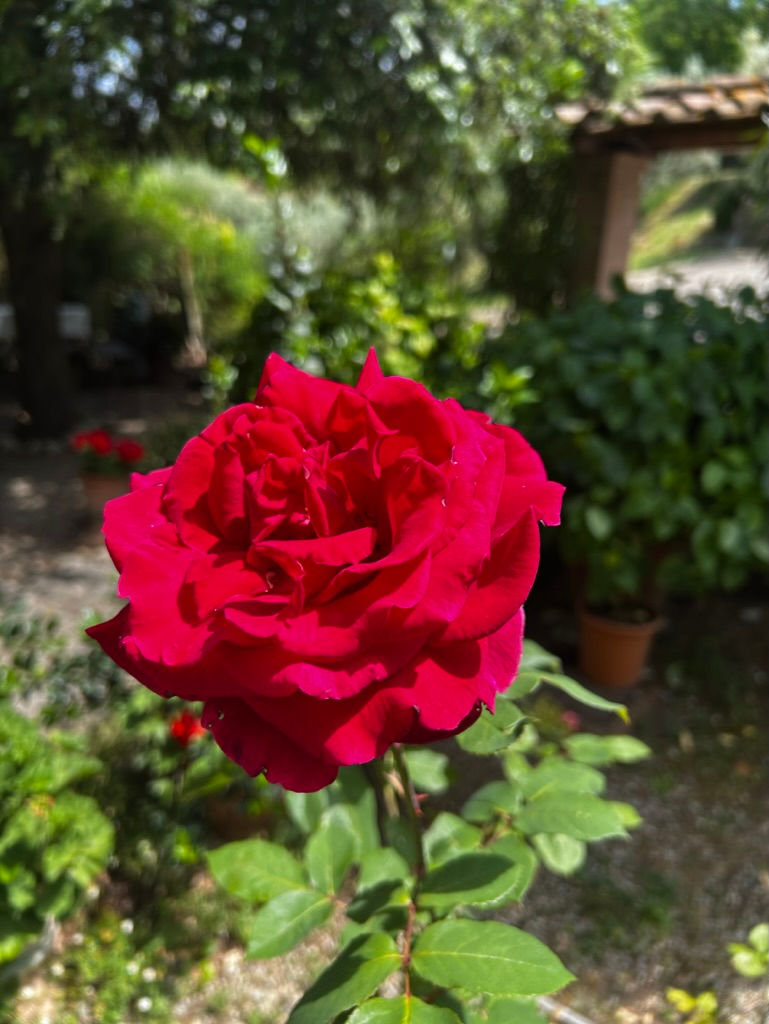
Doriano’s son Julio prepared our private table in the shade of their home garden for Lunch, complete with a single rose in the middle, bigger than a softball, lush, full, and fragrant, standing tall up to chest-height. We had a vast plate of vegetables and olive oil (which Fabrizio assures us is “very Tuscan” — not sure how unique a tray of vegetables is, but I believe him), the charcuterie spread of meats (incredible prosciutto) and cheese (fresh and mil aged local pecorino cheese — more on that later). He then brought us homemade pici (PEE-shee), a handmade pasta that is like very thick spaghetti. This very regional dish is handmade, each piece shaped/rolled by hand, with tomato, olive oil, and garlic. This pici we had here was incredible.


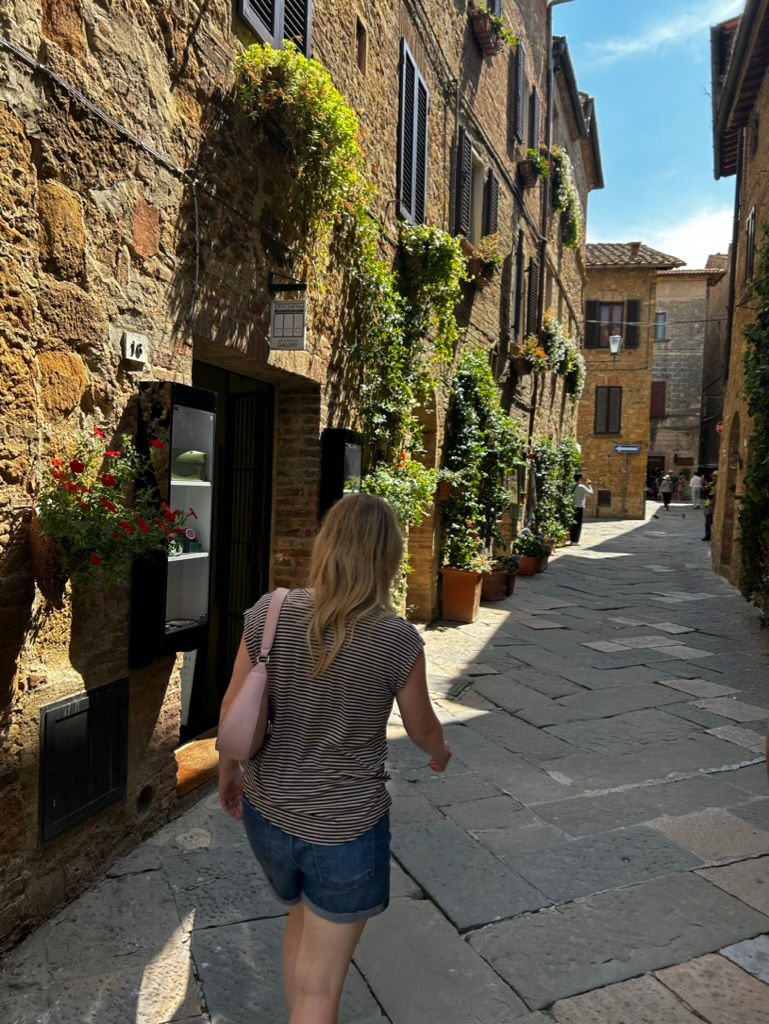
We visited Pienza to get lost in roaming pedestrian-only streets dripping with beautiful floral window dressing cascading into the streets — and sunburned tourists wielding their melting gelato and loudly comparing it to that of Florence and Rome. At the end of the “Avenue of Love”, the view opens to the most incredible panorama of the rolling valley. Any pictures (of most things from this trip) are laughably disappointing compared to experiencing them in lived reality.



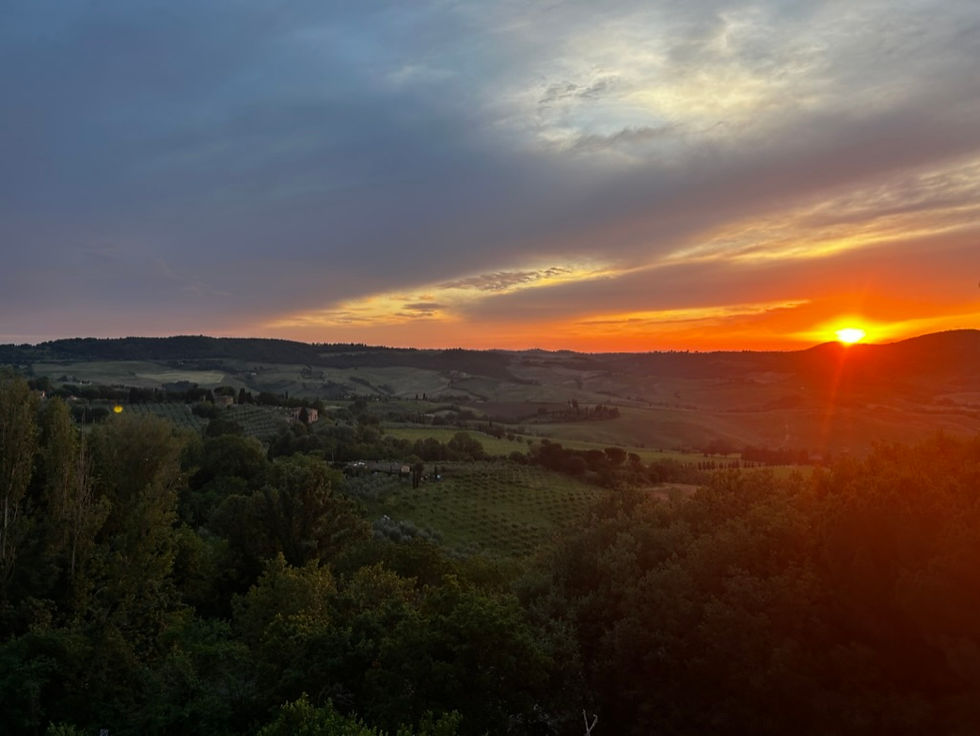
Arrival in Montepulciano. We stayed in a house listed as “Fancy Garden”. I found that naming hilarious. They did, in fact, have a lovely garden out front. It was small and nice. Not sure it was fancy or what would make it so. Sunset glowing in the distance.

Day 9. Friday 5/30/26
Montepulciano Day 2. Difficult hike. Bagno Vignoni Ancient Thermal Baths. Italian Street Festival (Sagra della nana (quack quack).
Can you imagine hiking 4 miles uphill then 4 miles back downhill a gravel road at a 8% grade in the hottest heat wave Europe has seen in a while “Under the Tuscan Sun”? (Book reference that put Cortona and a lot of Tuscany on that map and sparked a significant spike in American tourism of the area.) Well, we did that — but it was 15% grade. I don’t know how much you know about grades, but I can tell you for certain you should be equally afraid of a 15% on an algebra exam as much as a 15% grade hike. Probably one of the hardest hikes I’ve done due to the sheer intensity of the incline combined with the heat. We saw very few people hiking this trail. Most were on eBike and crazy people on regular bikes. The end result was incredible views of the rolling hills of the Italian countryside. Think “Sound of Music”, but more small hills with mountains (Appenines and others) in the distance.
Bango Vingone. Eventually reached it. Area of ancient baths (Roman Era). This location (the prime square no longer for bathing, just looking) has been a location of pilgrimage for millennia (not just centuries - wow), especially famous for Asian communities.


Ancient Wine Cellars and Bad Wine. We took a free tour of the Ercolani cellars in Montepulciano. Back in the day (a long, long time ago), these cellars under the city were used for aging wine, holding/torturing prisoners, and stabling animals. With the temperature as well, it plummeted down the creepy dungeon-like steps that just kept going deeper and farther from the starting point, mazing through tunnels. Everything stone and brick.
When vines would get a virus/parasite, they figured out they could split the middle of the vine in half and shove a rock between it. The direct exposure to sunlight would kill the virus and allow the vine to continue to grow. They had a display of cheese that used to be preserved with bay leaves and ash. The guide assured us that it wasn’t the ash of human remains. Really didn’t think of that until you mentioned it, Shanon. We peeked down a long, spooky staircase to a room that was a tomb from 4 centuries BC. I might not be good at time and history, but I’m pretty sure that was before lightbulbs and handrails were expected. I guess they were heading toward the ultimate light or darkness anyway.
The wine was horrible. Cheap. Badly made. Tourist Trap. Fabrizio (a licensed sommelier) managed to keep his act together until we left the place. I’m not som, but I could tell you that wine was yucktastic. Some aging barrels are more vertical to accommodate taller ceilings to take up less space. The mailbox door at the bottom of the red-trimmed barrel is for men (always men) to climb inside and clean the barrel after each wine is finished aging.


Sagra della Nana! We saw a poster for a local sagra happening and decided to go! Fabri told us a “sagra” is like a local neighborhood street festival (food, music, sometimes activities) usually put on by some sort of association to fundraise. This was a kids’ local football team (American soccer). America needs to adapt these logistics. We showed up out in the suburban/rural middle of nowhere to a small city with a football pitch. About 150-200 people in all showed. There were paper menus that you checked what you wanted (con piatti tipici e pizza = with typical dishes and pizza), handed it to a single kiosk, paid, and they gave you a number. After hanging around for a bit, everyone made their way to a covered tent area and sat down. The food and drink you ordered were brought directly to your table/number by the cutest kids playing on the football team and their siblings/parents.
“Nana” means duck. I think they call it a “sagra della nana” or “party of the duck” because they serve duck and they need a cute and cuddly mascot to advertise — and then eat. I ordered the cute little mascot. He came grilled with a crispy skin and was the best duck I’ve ever had (I’ve had my fair share of mascots) and probably was the best grilled poultry I’ve ever had (sorry, Mr. Dorsett). It was a big wow! It was a huge portion, and I could have eaten 3 of them; it was so good. Their house wine (like $15/bottle?) was also incredible.
Their live music was terrific, featuring Simona Fabrizi on trumpet playing jazz and pop charts. She had incredible tone and just an appropriately relaxed and fierce style for each chart.


House Wine. The “house wine” can be a wine that the house (actual home or restaurant) serves that: a) is a young wine that is good value — inexpensive and tastes good. This is often the case everywhere we’ve been in Italy. Or b) a young wine that is inexpensive and tastes bad because they don’t want to serve good wine and people will just tolerate it. This sometimes happens, but it is not often. At stateside Italian restaurants, both happen, depending on the quality/respect of the restaurants. I would say on average, it seems America serves less high-quality house wines.
Day 10. Friday 5/31/26
Montepulciano Day 3. Last Italian Countryside Bike.
Bombelone and Pistachio Croissants. Bethany was assertive in sampling the local “bombelone” (“bomb”) pastries everywhere we went. Think filled doughnut, but the fry on it is more crispy, and the filling is cream filling less sweet and more generous. I don’t feel sick after eating one as I do pretty much any American donut. (Sure doesn’t stop me. What human is strong enough to resist a Long’s donut?) I made the habit of sampling pistachio-cream-filled croissants as often as possible. Ya just don’t see those sitting at your local 7-Eleven.


Last eBike with Fabrizio. We had 5 total days biking with Fabrizio (I think). Each bike ride was usually 40-60 kilometers. Each ride usually went 10am-2/3pm We stopped halfway each time for coffee or lunch. Frequent stops to just oogle the jaw-dropping views. We never got tired of the views and continued to say “wow” 318 times each day. For our last ride, we had another incredible bike ride through the countryside. We crawled up iconic, postcard Tuscany zig-zag gravel roads lined with towering cyrus tress. These trees provide ample shade through the day — as long as it’s not 11am-1pm and your standing straight upright behind one. This ride was directly through Val d’Orca and it featured the most sprawling views across the whole region. Fabri told us that traveling Tuscany in May is an incredibly good time because the hills are still green (they turn brown in June/July), the throngs of tourists have not fully descended, and the sun isn’t yet set to “sweltering”.
We stopped for the cutest picnic at Caseificio Cugusi, one of two authentic pecorino farms in the region (sheep’s cheese). We acquired a picnic basket, filled it with a wooden board, baguette, 6 cheeses (ricotta, fresh pecorino, mid-aged pecorino, truffle pecorino, brie-style, spicy Italian seasoned pecorino), 2 jams (fig and strawberry), and an armful of prosciutto. Their property naturally sits on a hillside terrace with 5+ levels of picnic tables, flowers, and shade to dine “Under the Tuscan Sun”. (Never read it.)
Gelato. I learned that regardless of the size of gelato you order, the normal order is to get 2 different scoops of flavors. In Italy, I sampled: pisacchio, stracciatella, strawberry, Biscoff, hazelnut, lavender, Menton Lemon, and perhaps a few other flavors I inhaled. My favorite has been Biscoff. You get the olfactory reminder that you are traveling (Biscoff airline cookie — the only time I ever eat this cookie, so there’s a strong brain association to this flavor/smell = travel) combined with the fact that you’re already at your destination! So essentially, gelato is a teleportation device. (Certain flavors only.)
Private Wine Tasting with Owners Claudia and Marianna in Moltacino. Fabri set us up with yet again another private wine tasting in the cellars with the owners! The owners are in their 70s, speak no English, have refused outlandishly high offers to be bought out by other winemakers — and they seem happy as a clam. Their farm had about 50 chickens/roosters/turkeys, 20 dogs (for hunting wild boar), and an assortment of other small animals, and fresh cherry trees in season that we grazed from while walking through their vineyard [pinky out]. They prepared a charcuterie spread for us, this time with the addition of a thick honey spread, that I layered on the cheese like it was vitamin C the week before going back to school after the summer.
We sampled four vintages of Brunello, which is the grape for this region. Fabri continues to encourage the owners to up their current price (average €30) to be closer to the standard surrounding producers’ €80+. Each wine carried the distinct Brunello characteristics (robust, warm, long finish), but the 2020 vintage stood out. I have consistently found that this vintage across the board in much of Europe has done well. At least the grapes were thriving when we were all locked in doors during this time.
Pizza. For dinner (yeah, cuz we totally needed to eat again), we went back to the same casual pizzeria we went the night before because it was that good! The first night, Fabri, an experienced Italian, said the pizza was probably one of the best pizzas he’s had in his life. Um, hello? I had to check in on him later that night and the next morning to make sure he wasn’t delusional. He stood by that statement! The mushrooms were fresh and well cooked, the cheese had an incredibly generous stretch, the prosciutto (seems like a theme, doesn’t it?) was local and strong, the crust had a crunch and was bread-like, the sauce was tangy.
In Italy, it is completely normal to order a pizza for yourself, and eat the entire pizza. That is normal. Pizzas range from 7-13€ (from basic Margherita to more premium ingredients.) They are about a “small/medium” size compared to sad (sad) Domino’s pizza. On menus, there are usually 10-25 pizza options listed, which is so funny to me, because they are all just different combinations of toppings with a specific pizza name. Many names are the same across the region. More frequently in America, you have the American freedom to select which toppings you want or order specialty pizzas. I felt like I had to do a process of elimination and a hunt each time to figure out which was the life-changing combination. The answer: any of them are great!
If pizza and wine were this good and this cheap and this accessible and in this cool of spaces in the states, this would be an every-week occurrence. Fabri said he makes pizza with his family every Saturday. How cute! We used to do this as kids too. Who doesn’t love Pizza Night?
POP QUIZ:
The Tuscan Cheese, “pecorino”, is made from the milk of what animal?
A) cow
B) sheep
C) goat
D) girhaff
Answer: The last letter of the word “thumb”. Which, like, why is that letter there?
Day 11. Saturday 6/1/26
Elba Isalnd Day 1! Music & Street Food Festival
Elba Isaland (Isola del Elba). Fabri drives us 2 hours to Port Piombino, and we say our goodbyes. We board the Ferry on foot and travel 1 hour to the famed Elba Island. This Island is famously where Napoleon was exiled to. Additionally, this is the Island where Italians and Germans go to vacation, not Americans. It’s much more of an authentic/local space, free of American tourists because they don’t know about it and it’s harder to get to. For this reason, in the travel planning process, we swapped Cinque Terre for Elba, to experience more local traditions and space.
Seafood. I immediately ordered the fish of the day: local whole, langostas (small lobster? I forget the name. Prawns?), grilled octopus, and some of the best fried calamari I’ve had in my life. It was just so stinking crispy and tangy. I was proud that I was able to deconstruct the whole fish and keep the fillets intact. Not sure I’ve ever done that so successfully. Fish was good. Langostas were so sweet and delicious. Bethany enjoyed a mixed seafood risotto that was a comical serving for 5 people — not even the States would serve this much food!
Music & Street Food Music (“Mangiami”) and the Plant Festival. This trip is focused on experiencing local traditions and experiences. One of those highlights was exploring the 3-day Plant Festival and 5-day Music & Street Food Festival. We saw so many new plants that we have never seen before! Gardening is a traditional habit of many native Italians. Cultivating a garden, window-dressings, and plants throughout the house is a very Italian thing. You can immediately spot local homes vs rented/tourist spaces throughout Italy, because the local homes always have an abundance of greenery and flowers.