11. Copenhagen, Denmark -- "1st Place Happiest City on Earth"
Featuring meeting two marvelous maestros in two days. And one of the coolest tours I've ever been on.
Day 31. Sunday 6/21/26
Morning casually getting coffee, trying to figure out what the heck we're doing today. I realized that the only remaining tour for the Copenhagen Opera House starts in 34 minutes — on the complete other side of town. We decided to go for it. While walking, navigating, and boarding public transit, buying tickets in a mixed-language app, loading my credit card on a rollercoaster bus -- not exactly the Mission Impossible setting, but it felt like it for 34 minutes.
The Royal Danish Opera. Went on a guided tour. This was such a special and beautiful tour! Ah! Sebean (suh-BEAN) was an actor in the company who gave the tour, and she delivered 90 minutes of rehearsed, enthusiastic, and engaging performance via the tour. Not dramatic, just strong narrative and clear articulation. She beautifully synthesized the narrative of how history, function, and artistic design combined to build this facility.

Photo from me from the water. Here’s the roof of the opera house, which casually doubles as the “Red Bull Cliff Diving” platform, which is a big event each year. . We left 2 days before it.

Photo from Wikipedia. Better shot than the ones I took.
Among the most modern opera houses in the world (built 20021-2025) and one of the most expensive opera houses ever built at 2.5 billion DKK (~$500 million at the time). It’s construction was a tense rivalry (not heated — totally different drama there) between the architect (Henning Larsen) and the funder (Maersk). Maersk is the owner of the second-largest shipping company in the world (700 vessels, the owner of the shipping company that runs the world and has run the world for ever). They disagreed passionately about the design. When it was completed, the architect said horrible things about it (his work), saying how ugly it was, due to believing Maersk ruined his vision. Artists, am I right? If you're curious, https://henninglarsen.com/projects/the-royal-danish-opera
It’s incredible. The outside looks like a modern shipping ship. The inside looks like the wooden hull of the ship, flying above the water. The entry catwalks look like gangways (boarding bridges) to the ship. The space is designed to feel enormous, but with stragegically spaces barriers to make it feel smaller and homey. The geographical structure is poetic and brilliant, called the “line of power”. All of these are in one line, aligned like the stars: The Marble Cathedral (not made of marble, representing God), the parliament (government), the harbor (nature), and the opera house (art). These four represent the pillars of society. It gives me goose bumps to write. The front steps of the church and the very middle of the symmetrically divided parliament quarter perfectly align with the entry door to the opera hall. How cool!
POP QUIZ.
For most of opera's history as a genre (18th and 19th centuries), operas were:
a) high volume -- a relentless treadmill of options to satisfy audienced/nobility
b) disposable scores -- a few weeks of performances, never seen again
c) recycled plots -- heavily formulaic, repetitive tropes, boring stock characters
d) all of the above.
Yup - It's the last one!Opera. Boy, we don’t have time to break down anthropological and cultural studies here, but here’s my short thesis (one of many). For much of time, Opera didn’t need to be good. It didn’t need to be high quality (and often wasn’t). It didn’t need to make sense. It didn’t need to be real. Opera was a place for people to go, be seen, see others, do business deals, deal in gossip, be entertained, to experience art, and forget about their lives. It was more about the people’s experience in the audience than what was happening on stage. The halls were decorated to be elaborate, ornate, and beautiful to show off wealth and to look around. Over time, opera has developed into a much more refined production (higher quality of all elements) than it used to be.
They designed the hall to reflect this new aesthetic. Extremely minimalist and neutral interior to focus all the attention on the stage, so now the art is the focus. Groupings of 7 everywhere (the lights, wood paneling, etc) is a nod to the logo of the shipping company.
The roof is supposed to be “subtle and muted” — casual simple panels… covered in gold leaf.
The walls outside of the hall: The stone walls throughout function as a giant marimba that you can play by knocking on! (Non-sequenced pitches, so not laid out like a piano). Guests can go up to any (most) walls and knock on them with their visits and make music themselves.
When we went in the hall, they had the Lighting Grid down — looks like a giant checkerboard — so they can set the bajillion light cues for the show. When they do shows, they bring in the shipping container of all the set pieces, and props, and/or unique costume pieces that were packaged up from the last time they did the show. There are hundreds of people involved in putting a production together. Everyone must trust everyone else to do their 0.3% of the job correctly/well to make the whole machine work.

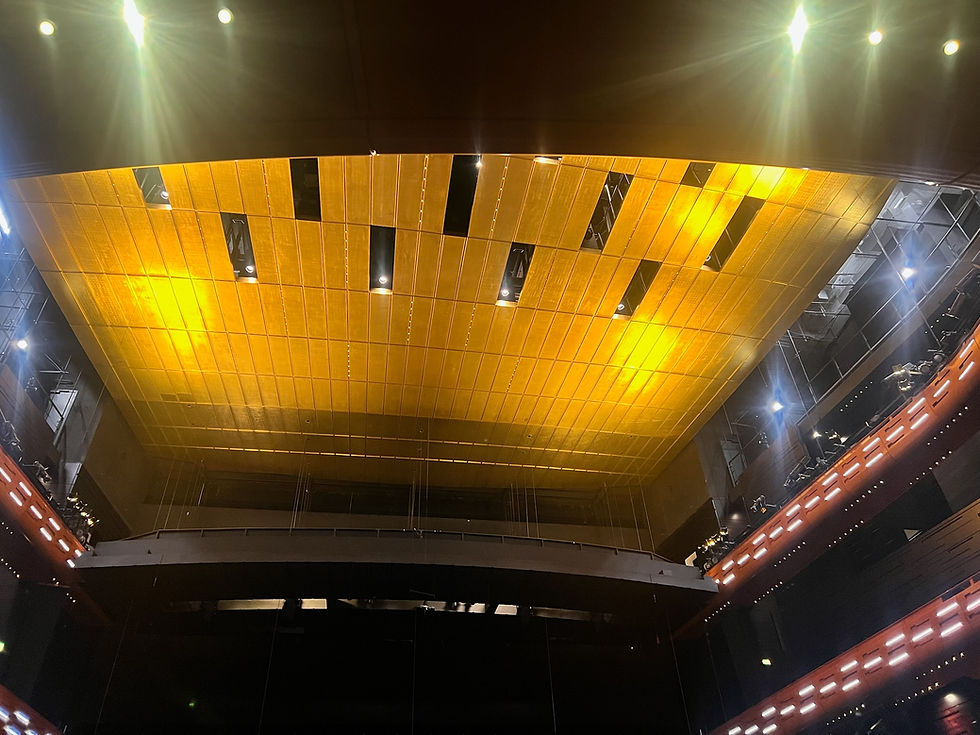
Backstage was unlike anything I’ve ever seen or heard of.
Wow #1)There are 6 stages “backstage”. There’s the main stage, but then 5 additional stages backstage in the wings. These are used for rehearsal halls and set building and anything else they need. So they can literally have sets/rehearsals for multiple productions all happening at the same time.
Wow #2) The floor moves. Like every 4x4 foot square can modularly move like a science fiction movie or Amazon warehouse. The floor squares uncouple from the other squares, move below the floor, shift all around, and move the entire set piece, piano, and costumes, to the other side of the stage. My jaw was on the floor through this whole backstage tour. Look closely and you can see the floor moving in this 1-minute time-lapse video.


I didn't realize a salad could have an entire wheel of baked camembert cheese with honey drizzled all over with walnuts and fresh figs. Best "salad" I had in all of Europe. And fancy Smørrebrød, which is the most traditional Danish food. Smørrebrød "butter bread" (colloquially pronounced "smur-br")is a traditional open-faced sandwich made of a piece of buttered dense dark rye bread topped with cold cuts, fish, cheese, or spreads. They get real creative with what can go on it. This one was a simple chicken salad.

LEGO is a Danish brand. Went to a store. Almost bought this. The price is still scary after the DKK to USD conversion (USD cost = 15% of DKK cost).

I’ve seen a lot of statues of men (always men) on horses. But this is my first any of them wielding a hatchet. This is Bishop Absalon, who founded Denmark in 1167 (with a hatchet).

I was newly introduced to the Scandinavian world of “aquavit”, which is a spirit distilled from assorted herbs at a high ABV. This is “the drink” in all of Scandinavia as an after-dinner digestif. Very herby, very high alcohol content. Always served as 4 deciliters (a shot an a half?). Had an incredible six (?) course chef’s menu of Scandinavian cuisine. Fish, mustard, egg — these were the main themes, but it was more refined and interesting than that — really outstanding meal.


Day 32. Monday 6/22/26
We watched a marching touring band rehearse part of their set on the side of the street. There were 40 students; the director said ages 12-19. I cried 8 times (eyes watered in 8 separate instances). I was so moved by the students’ authentic joy and movement in their playing. They authentically were expressing with their bodies the motion and style of the music in their movement and choreographed/nonchoreographed dancing. Additionally, they sounded terrific. Tight, balanced, levels. I was so moved to see them making “music for the sake of music”. Not for competition. Not for a score. For themselves and for others.

Collaboration with Maestro Michael Bojesen, music director/educator/composer. He’s the guy in Denmark. I sent him a cold email (warm message), and he kindly obliged. Maestro Bojesen kindly invited me to come catch the end of his day’s recording session at the local TV studio. The project he is almost finished with is recording 800+ Danish songs (popular/hymns/carols/folk — a little bit of everything) from the most recent Danish songbook. This is the songbook that is used in high schools to teach/learn these traditional songs. He kindly gifted me a copy of the songbook to use in my classroom.


After being buzzed into the studio, I sat in the control room and waited for them to finish their recording. All of these videos are publicly available on YouTube and are broadcasted everyday at 10am on the local radio station. Each recording is a short history/context lesson, a conversation with the singer of the session, and then a sing-along style performance. He explained the project clearly: to provide resources for the community to have access to this singing tradition and to support their participation in singing together. After the recording session, we had a terrific chat about all things music, education, and composing. Big inspo -- what a guy!

More Smørrebrød! (The lack of outfit change here is a betraying timestamp.)


(I think traditionally, 1 person is supposed to eat only 1 sandwich...)

Day 33. Tuesday 6/23/26
National Museum of Denmark. Ancient civilization is old. Looked at lots of rock and bone relics from the past. Perhaps the most interesting were the runes. These were ancient markings used by pagan traditions to mark the memory/death of others. Their reputation was seen has highly important, thus setting their name and reputation in stone (name, son of who, and how/when they died).

There was an exhibit about money and banking. Here are some gems:
Me picking up and holding a bar of gold! (First time to be honest.)


We went to the Midsommer Bonfire lighting. Midsommer is like on of if not the biggest, holiday is most Scandinavian cultures. The pagan holiday celebrates the summer equinox (the longest day of the year) and the associated fortune and hope that accompanies this time. Huge event. Like 8,000-10,000 people gathered along the harbor and pier. Watch [name of artist] perform, who is a significant pop icon in Denmark. Language was mostly in Danish, but familiar American idioms and filler words were thrown in there. Generic expressions relating to love, feelings, and cursing.) At the time of the lighting of the giant bonfire, she led the audience in singing the traditional “Vi elsker fort land” (1885). (Metrically very interesting shifting between compound and duple meter.) The bonfire was the size of a semi-truck. A little scary because the teepee shape collapsed to the side after a while. Firefolk were spraying it with water constantly around the base anyway to keep it contained.


Day 34. Wednesday 6/24/26
Rosenborg Castle. I bought a ticket with an audio tour. Kindly told a guide I was an educator and asked if I could join their guided tour for the rest of the way. One of the smallest royal residences. It was outgrown almost immediately after being built.
Big metal orbs in front of the fireplace emitted heat more evenly throughout the room. The side tables were filled with coals from the fire to keep food warm.

The throne is made out of unicorn horn. Unicorns are a special and rare animal. That’s what the king told everyone. They were actually made of narwhal tusks — which is so interesting the more closely you look at the ornate carving. They also had an impressive museum of ivory sculpture, which was trendy to them.


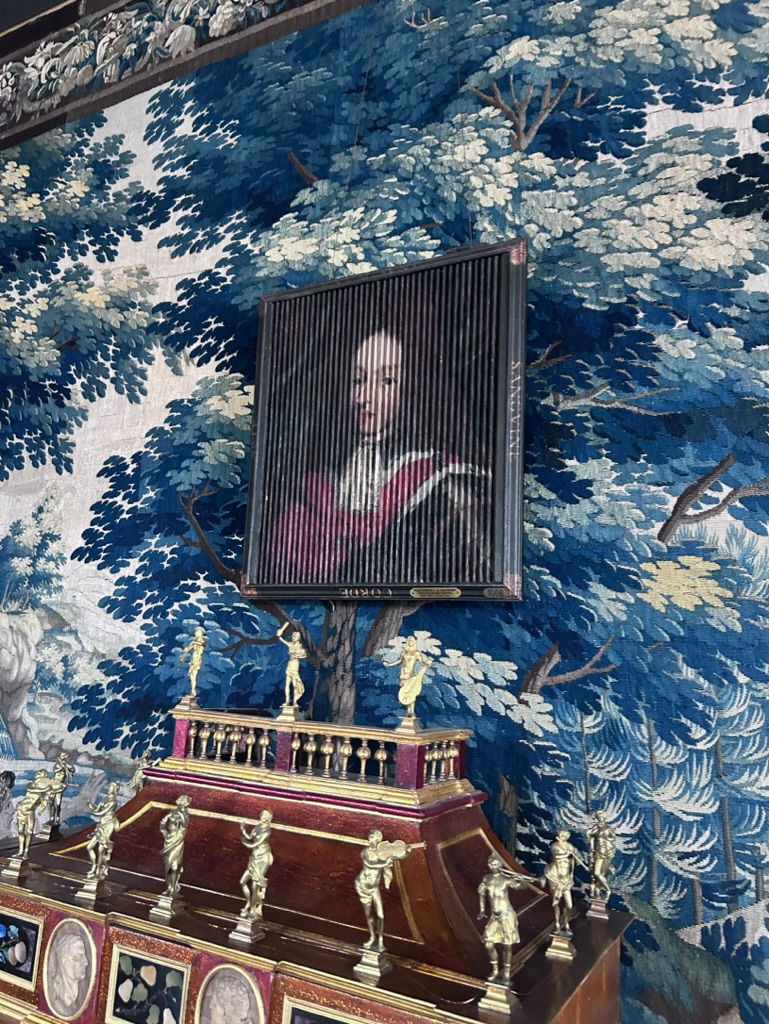
Lenticular Portrait of Frederik IV and his sister Sophie Hedevig. A singular portrait with a triangular design to show two images from different sides. Not sure how old this is, but this seems like a pretty quirky older optical illusion wall art.

The crown jewels. Skip the crown jewels in London (okay, those are pretty cool), but these were stunning and more intimate. Fun fact: the queens could repurpose jewelry however they wanted. They could reconstruct the jewels and metals to make different items. These sets are the most recent editions that had been revised and changed through the years. The king’s crown of Denmark from like forever ago was actually sold to someone in Germany a while back. Then Denmark bought it back. Beautifully ornate ivory carvings on both the king and queen’s crowns.


At lunch in a street market. I almost ordered one of everything, but that would have fed the entire neighborhood. I settled on a salad/chicken skewer combo that featured three different kinds of premade salad put together. This was the heaviest salad I have ever cradled. I have held lighter new-borns.

Christiansborg Palace. Today’s government building. Went to the top for views of the city.

The Round Tower. Take about 10 stories up, but around. This has been and continues to be a significant solar observatory for the region and Europe at large.

Ate from the famed DOP sausage stand. Yes, there’s a map for finding sausage stands in Denmark. Yes, I used it. Yes, it was delicious. Here's the website: https://hotdogmap.dk/

Canal Concrete Beach Culture. When I think beach/swimming, I think Flordia/Carolinas sandy beach. Well, there’s a significant part of the world that has “concrete beach culture”, where the beaches are the manmade concrete piers next to the water, like all of the canals in Copenhagen. The water is incredibly clean because of significant eco/lifestyle actions from the city and people. It was very warm out (80s), and there were people everywhere sunbathing on the concrete on various piers and swimming, in both designated swimming areas and many non-designated swimming areas.

This was new and shiny to me, so I was eager to participate! I brought some shorts and jumped in at Kalvebod Bølge Badezone, one of the official swim beaches near Blox and the National Library.

Attended an incredible choral concert at Church of Our Savior, put on by Kammerkoret Hymnia (Hymnia Chamber Choir) led by the remarkable conductor, Maestro Flemming Windekilde. The first program was all living composers — three of whom were present that I enjoyed meeting and talking to after the concert. The back half of the program was all older, more “traditionally Nordic” music. I enjoyed engaging with the conductor and the composers and look forward to continuing to collaborate. I so enjoyed hearing about the composers' approach to language, composition, creativity, etc. They were excited to chat and so was I.
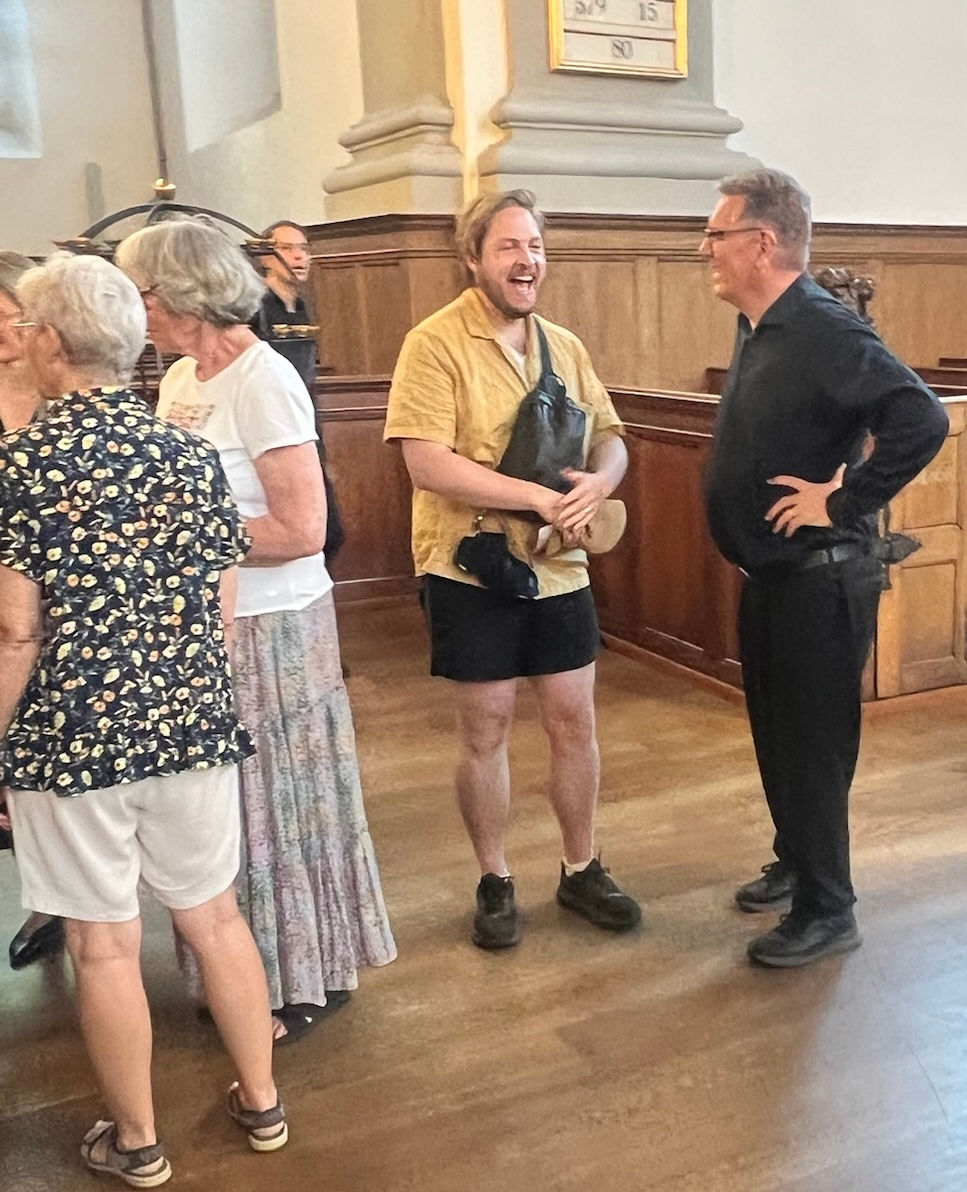

Whispered from me right before the photo: "Please excuse my smell and dress -- I just jumped in the harbor and dried on the walk over here."
Next stop.... Sweden!

